Category Archives: Uncategorized

Canal du Centre, the Saône & Doubs Rivers and Canal du Rhone au Rhin 2- 8 June 2011

We left the Loire in a pensive spirit and headed alongside the Canal du Centre into Burgundy territory where we were looking forward to expanding our palates with more “degustation” sessions. The wide, sandy flood plain & golden arable land of the Loire became a greener and more rolling landscape. We approached Beaune, in the heart of the Bourgogne wine region, and every inch of land was devoted to the vine, far more exclusively than in any of the Loire wine regions we’ve cycled through.

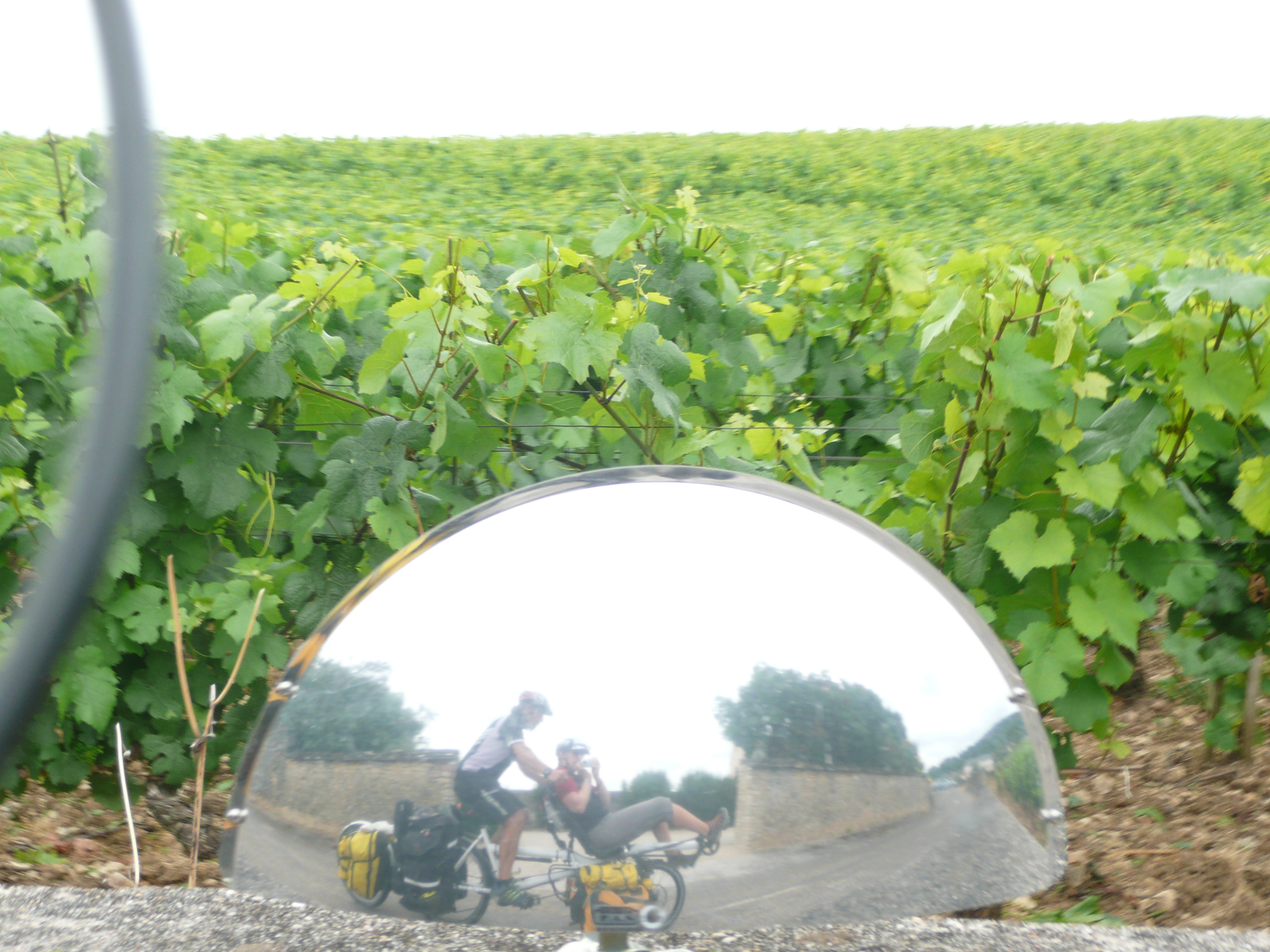
Sadly our limited wine knowledge left us a little embarrassed when we strolled into the first vineyard and discovered most of their bottles cost the same as our entire day’s budget for food, accommodation and everything. We explained our limited means and the lady of the house kindly gave us a guided tour of her cellars and a couple of tastings. She had wines dating back to 1917 and which cost over €400 a bottle. The condition of a wine of such vintage can’t be guaranteed, so if anyone wants to buy a bottle the lady lays on a sumptuous meal for them at her house and the bottle is then opened. If it has spoiled then she has recourse to her cellar to open a different bottle. We were taken aback initially at the condition of the cellar….mould draped the ceiling and covered the bottles to a depth of a centimetre or more….but apparently this is because wines should be stored in damp places to stop the corks drying out. We’d known that the corks shouldn’t be allowed to dry out, but hadn’t appreciated just how damp and dank the ideal cellar would look.
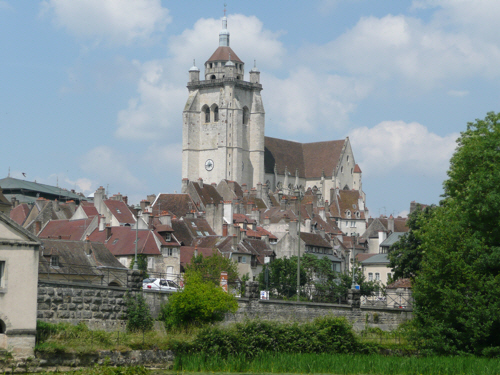
Dole Church

Happy birthday to me, happy birthday to me! We celebrated my 39th birthday by treating ourselves to a night in a campsite (showers!!) and a meal out (our first non-campsite meal) in the well-preserved old town of Dole, birthplace of Louis Pasteur, which is dominated by a huge cathedral that imposes itself above the maze of 16th & 17th century streets that jumble up the steep slopes from the canal to foot of the cathedral. The weather had been overcast during the day and in the evening a huge storm descended. Luckily we just made it back to the tent after our night out when the storm broke, and we stayed cosy and dry listening to the rain clattering off the canvas and the cacophony of staccato calling from the frogs in the adjacent canal.

The scenery changed yet again as we made our way along the Doubs. Densely forested slopes rose immediately from the canalside with pretty brick villages and gaudily tiled ‘cloche’ bell-towers appearing magically from amidst the foliage.
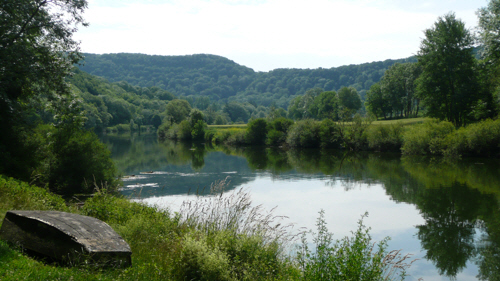
Doubs Valley

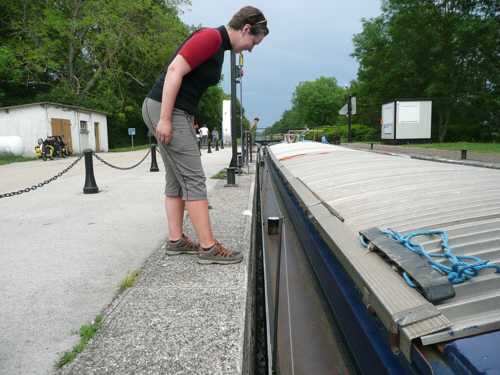
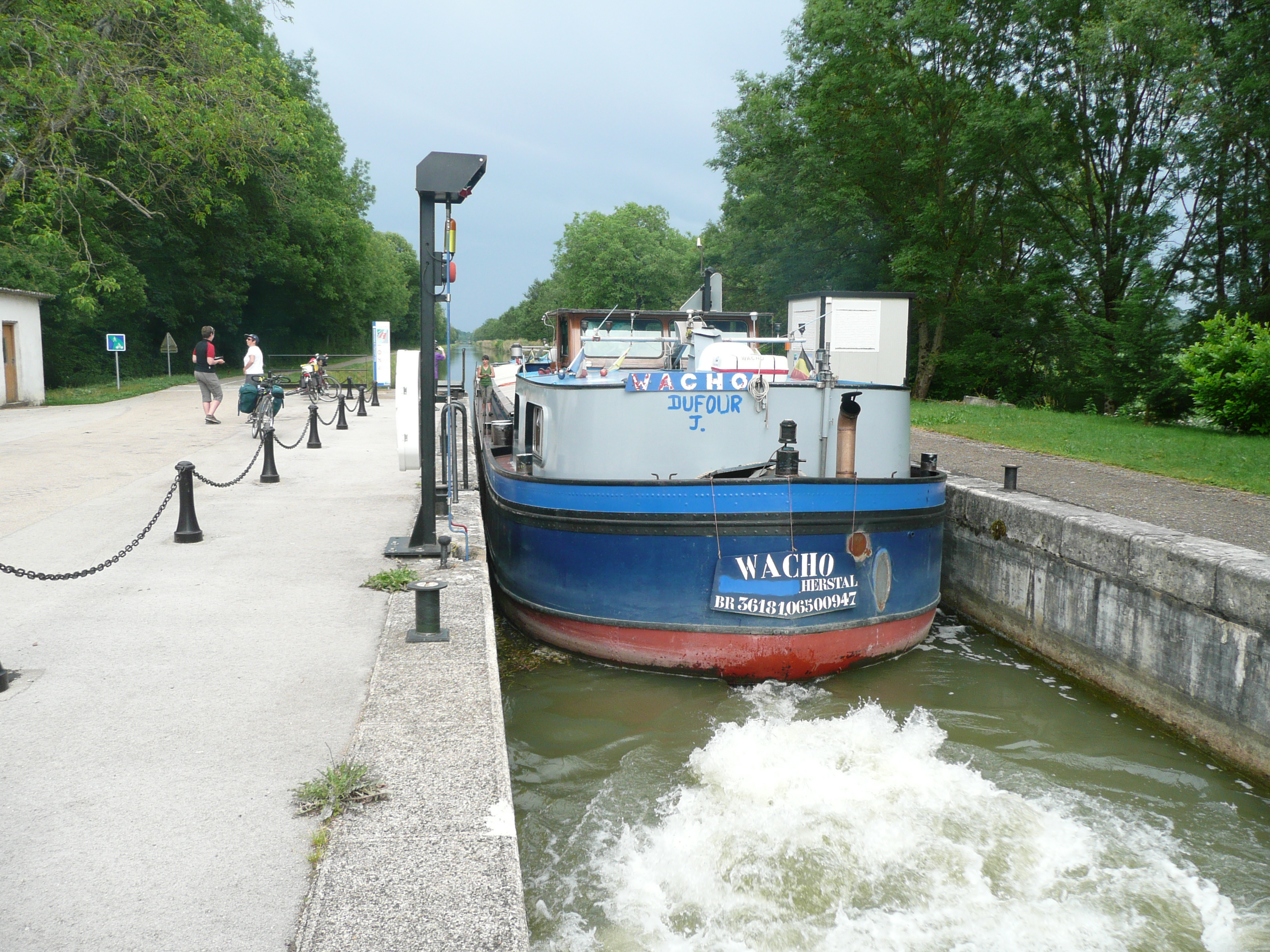
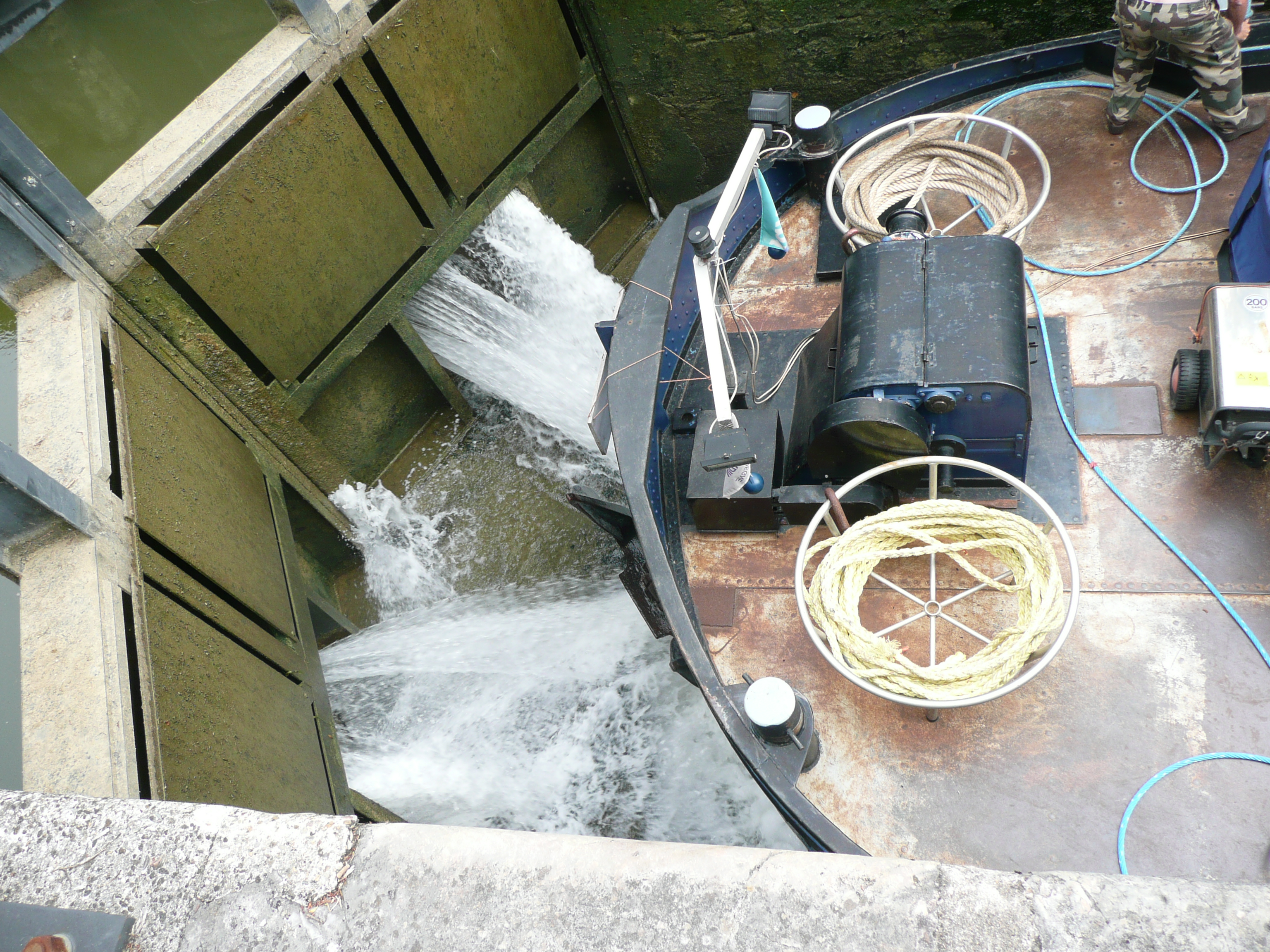
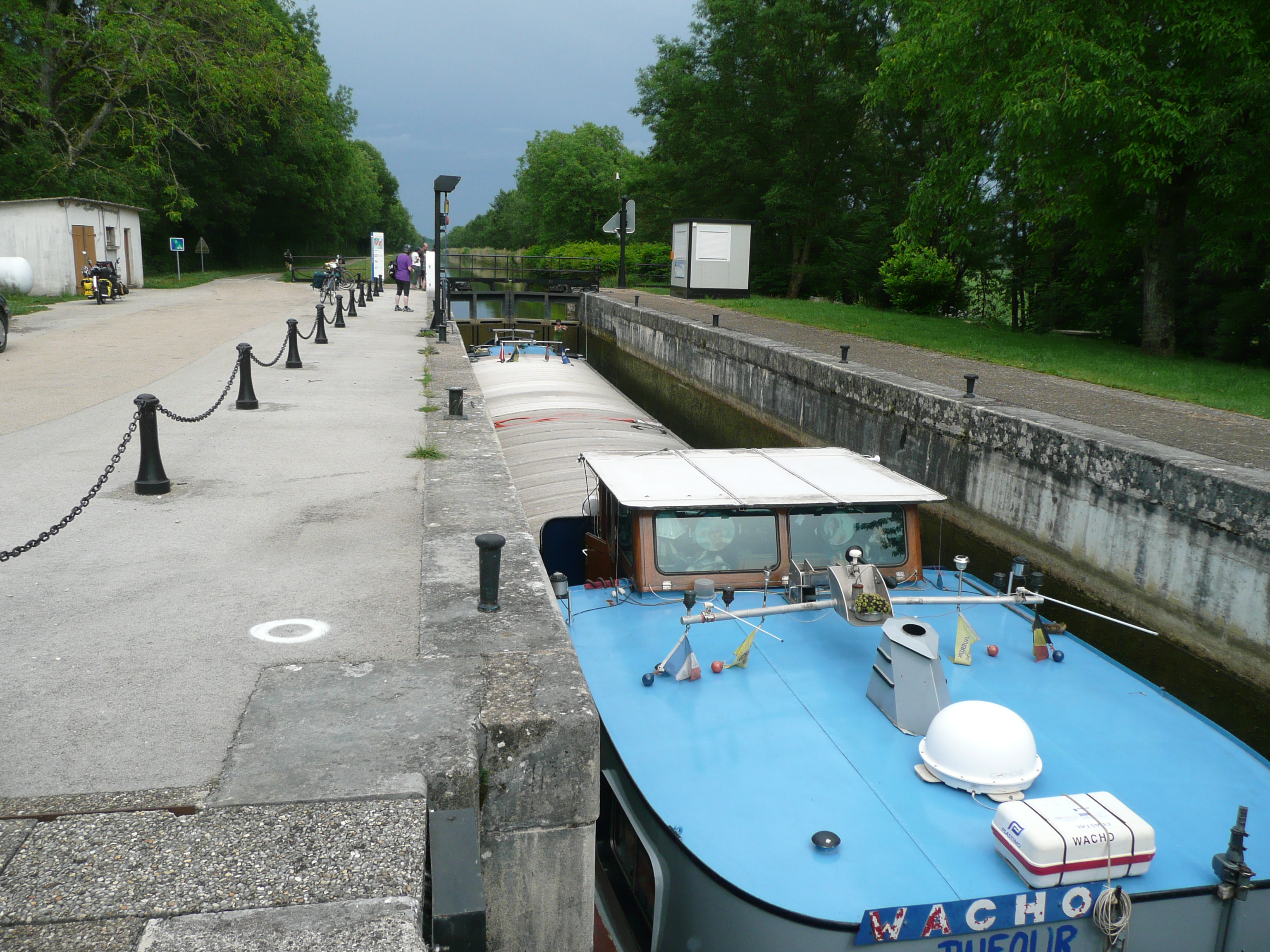
The Doubs river and Rhone\Rhine canal seem to run adjacent to each other and often intermingle, with boats being directed to the most suitable waterway as required. We’d spotted some huge cargo barges and wondered how on earth they could get through the locks…the boats looked to be much bigger than the lock. We were both intrigued therefore when we saw one of these leviathans of the waterway entering into a diminutive lock. It was very impressive. The huge barge had to get absolutely lined up before inching forward with about 5 cm to spare on either side between his huge bulk and the walls of the lock. Once in with the gates shut, there was perhaps a metre to spare at either end. As the water rushed in the barge driver had to keep his engines ticking over to counter the rush of water into the small space remaining at the front, and inexorably the barge rose without hitting the side once. Very impressive. The couple working the barge accepted our admiration for their boat-control skills and told us they were carrying 180 tonnes of sunflower seeds to be turned into oil. We saw them a couple more times over the next few days and waved enthusiastically at each other, but didn’t find out where they’d come from or were going to at their sedate and frequently lock-interrupted pace.
The weather remained a little unfavourable and we arrived in Besancon dripping wet and took refuge in a warm cafe for an extravagant brunch. There’s a citadel up on a huge rocky outcrop and the canal goes underneath it in a tunnel. This pleased Keith, who enjoyed pedalling through it. I enjoyed the respite from the rain, which pools unpleasantly in your lap on the recumbent seat.

We’d hoped to go to the Peugeot museum in Montbeliard, but a more pressing need was to locate the Decathlon to buy gas, and then we noticed the black clouds rolling in so, as it was already after 6 and the museum most likely about to close, we started to head out of town in search of a suitable camping spot. The decision was made for us when the black clouds caught up with us and I just had time to sling the flysheet up whilst Keith put the covers on the panniers, and we then huddled in our hastily assembled shelter for an hour before there was sufficient lull to scamper out and retrieve some crisps and dip, and then later, in a more substantial lull, to reposition and assemble the tent properly and get some dinner cooked. It was still raining the next morning, but eased off by lunchtime when we reached Mulhouse and ate our bread and cheese in front of the hideous pink town hall.

Mulhouse Town Hall

Our last afternoon in France brought a real treat with it, as we pedalled along by the peaceful canal, I saw a large, sleek brown shape slip from the bank into the water. Presuming it to be an otter, we stopped and watched it swimming away from us, expecting it to disappear from view any moment. To our amazement, it then turned and swam towards us and came right over to where we stood on the shore. As it approached and raised its grizzled, whiskery face from the water, instead of the broad, flat skull and carnivorous teeth of an otter, we saw a rather large guinea-pig-like visage complete with rodent incisors. The tail was round in profile, not flattened like a beaver’s and I think it might have been a coypu as I believe there are some that were farmed for fur now living wild in France. There was a whole family of them, large and small, and we watched them for 10-15 minutes before continuing on our way to Basel.

Coypu?

Roscoff to the mouth of the Loire 13-18 May 2011

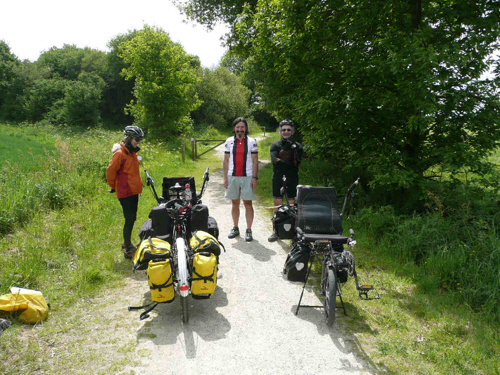
We left Roscoff following, for the most part, veloroute 7 and heading southeast. After Morlaix this was exclusively on a disused railway path, ie mostly flat, easy navigation, no traffic, and a gentle background of birdsong and the whirr of our tyres on a good hard-packed surface. And (did I mention?) it was predominantly pancake-flat. Lovely. Then to top off a good day back in the saddle we saw another bike like ours – a semi-recumbent Hase Pino tandem. We’d just sat down on the picnic blanket for a lunch of baguette and camembert when to our astonishment a black Pino hove into view coming from the opposite direction. Who’d’ve thought?

Two Hase Pino semirecumbent tandems on a cycle path

That evening we camped near Mael-Carhaix on the grass verge next to the velopath, by a field with a couple of young horses in who were simultaneously intrigued and alarmed by our tent. Wild camping isn’t strictly legal in France, but the couple who owned the horses and adjacent field of cows walked by and were not bothered at all by our camp.

The next day we picked up another veloroute, again on a disused railway, and headed east to Mur de Bretagne before turning south to pick up the trail alongside the Nantes-Brest canal. You’ll notice a theme here for seeking out the flattest routes possible. I don’t think our joints have quite got over the exertions of the Yorkshire Dales.

The canal meandered somewhat between Mur-de-Bretagne and our destination of Josselin, so we’d intended to detour off onto the roads to cut off a considerable corner, but in the end were enjoying the easy canal-side riding so much that we stuck on the canal all the way to Josselin….via Pontivy….and then looping back northeast before dropping southeast to Josselin…making a 120km day. The day was made longer still by the intervention of an enormous oak tree that had fallen over across the path and into the canal just 20 minutes before we arrived. The area round the roots was very overgrown with brambles so we dismantled our rig and lugged our gear over the huge trunk. However, what had turned into an unexpectedly arduous day finished well with an evening of luxury courtesy of the parents of a club-mate, who’d kindly arranged for their neighbour to let us into their home even though they were back over in England….much appreciated!

After our long canal/tree-climbing day we both felt a little weary so the following day started slowly with some laundry and washing the bike. We finally left Josselin around 3pm heading south on, as had become our norm, a mixture of canal path and disused railway. The Pino was much admired wherever we went and one old boy and his wife were particularly taken by it. After as in-depth an explanation as we could manage in Franglais of the pros and cons of the Pino, the old boy wrote down the Hase website details and also the name of a local shop that sells them (info supplied by another cyclist who’d joined the throng). The old guy seemed particularly keen and I think saw the Pino as a way to get his wife riding again. He proudly announced that he was 88 years old. His wife immediately piped up ‘moi aussi’, but I think she might need a little more persuading on the bike. I hope they get one though – the stoker’s freewheel would be easy on her decrepit knees.

Our short afternoon’s ride culminated with extravagant (by our budgetary standard) beers in the pretty town of Malestroit and then a nice wild-camp spot in a stretch of woodland alongside the railway path.

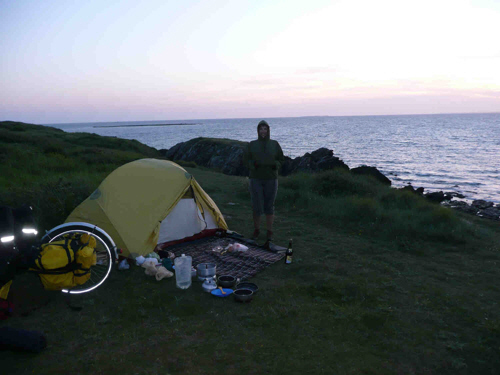
The next day we reached the Atlantic coast. It felt like something of a milestone to see the sea again. We meandered slowly around the convoluted, rocky coastline and approaching Piriac-sur-Mer found a beautiful, albeit windswept place to camp on the clifftops, hidden from the road by dense gorse bushes. A few joggers and dog-walkers came by but no-one was upset by our presence.

Our clifftop campsite

The next day, after a stop for some wifi surfing in Piriac, the road headed inland and took us through an extraordinary landscape. For miles we cycled through an immense series of shallow, rectangular ponds, interlinked with water channels. Some were overgrown with weeds but most were barren and simply contained slightly slimy looking water. We stopped a number of times, wondering what the ponds were for, and eventually decided they might be for extracting salt. It turned out we were right, but we’d never have guessed how complex and time-consuming a job it was. In the middle of the salt-lakes we found an exhibition centre that showed how the process worked. Salt workers actively manage their plots year round and using techniques that have barely changed for 1500 years harvest an inconceivable amount of salt each day over the summer months. Guerandais salt is a premium product, valued across France. We couldn’t afford it.

Man tending to his salt harvesting pond

After an educational afternoon we continued along the coast road looking for another suitable camping spot…but nothing was forthcoming and we found ourselves in an increasingly urban and tourist-infested area around Le Croisic. Eventually, we capitulated and decided to look for a paid-for campsite, and in doing so we stumbled by chance upon a small fishing pond with a secluded spot behind some bushes that was perfect for a sneaky camp. With the wine open and the trangia on full gas we enjoyed an evening watching the sky change and listening to the seagulls splashing in the pond. We were interrupted just once by an enthusiastically galumphing Labrador, whose owner walked within a metre of us and never even knew we were there.

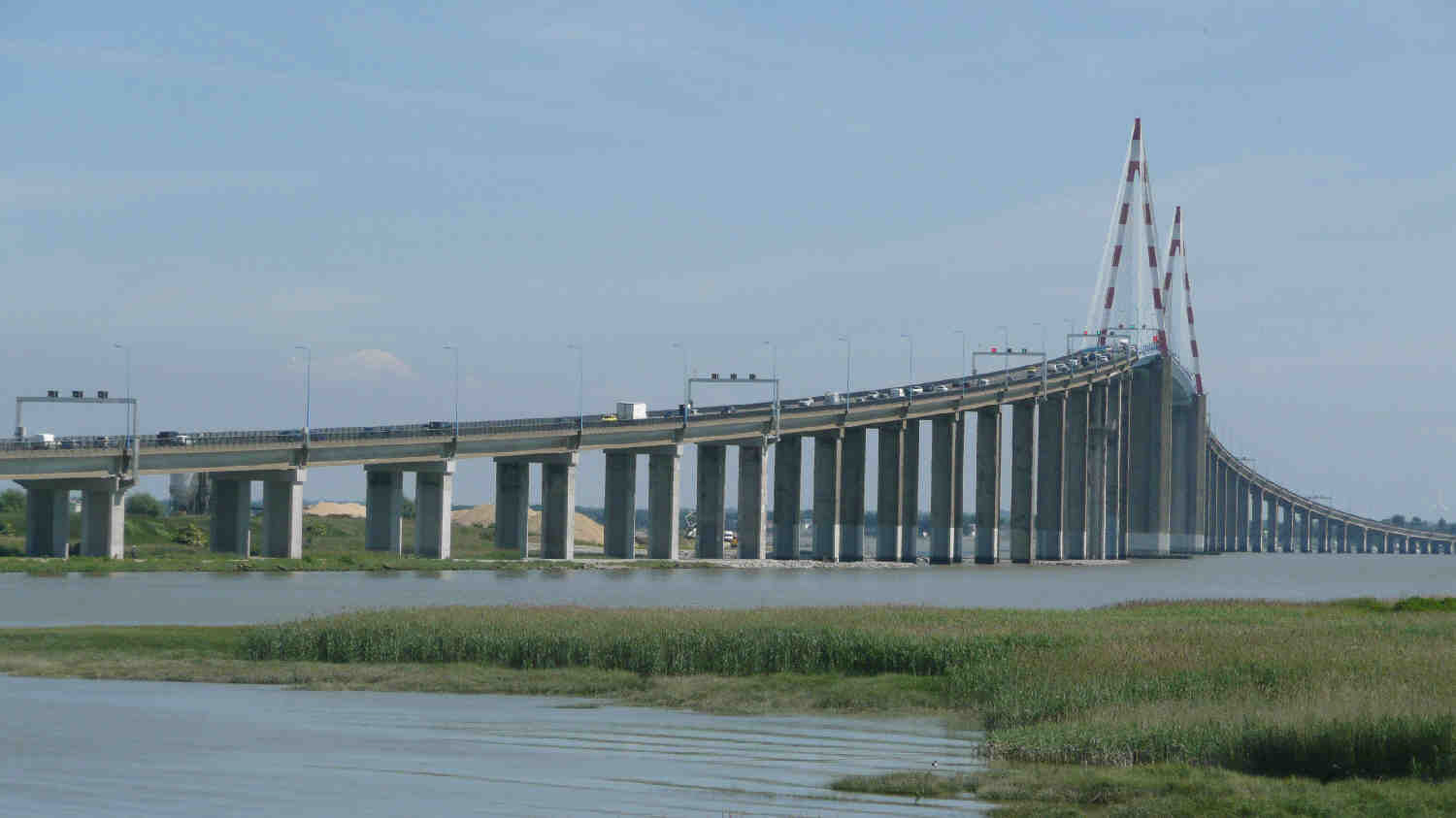
Our sixth day on the road since leaving Roscoff saw us finally reach the mouth of the Loire. The bridge over the Loire at St Nazaire that is the start of veloroute 6 – the Atlantic to the Black Sea.

Bridge across the Loire at St Nazaire

This area is historically significant as being one of the last areas to be surrendered by the Germans at the close of WW2. We spent the morning nosying around an old German bunker which now contains an excellent museum, before heading along the beachfront at St Nazaire and over the bridge. The bridge itself is around 3.5km long, rising steadily (and very slowly on a loaded Pino) before descending again for an exhilarating run to the start of the Loire cycle route. It took us ten and a half minutes to cross it. Once on the south side of the Loire we followed the route-guide onto a horrible, sandy trail that was barely ride-able. The redeeming feature was that we happened across a film-crew making a short programme about the Loire veloroute who were delighted to have us on set. We smiled for camera and did a couple of takes riding in the opposite direction to a family with very white teeth who we think were there for the filming rather than just passing through as we were. If you find the film on the interweb at any point do let us know.

More on the Loire section of our trip in the next update…

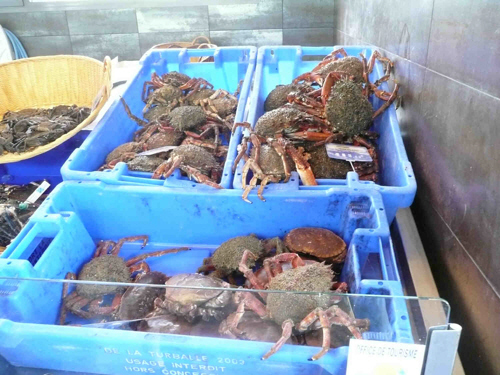
Crabs at the market