
Alternatively, Slovenska, Magyar, Hravatski & СРБИЈА (or Slovakia, Hungary, Croatia & Serbia)
OK peeps, it’s been a while, but the travelogue bit of this blog (ie before Keith’s grouch about cyclepaths) last saw us in Bratislava so I’ll continue from there and apologise in advance for the length of this post. A lot’s happened.
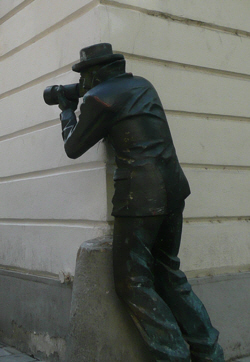
Ignoring the shortcomings of the campsite in Bratislava, the city itself turned out to be really pleasant. The old centre is not too big and is full of quirky buildings, bridges and statues…including the world’s narrowest building, a bridge that has a UFO on top of it, and a statue of a paparazzi snapper sneaking a photo around the side of the building. As usual, the Pino was the centre of attention and it was difficult to get anywhere without having to stop and answer questions and pose for photos.
From Bratislava it was only a short distance to the Hungarian border, where it really felt like our journey was starting to get adventurous as the veloroute sign was full of bullet holes….what sort of reception should we expect as we headed down the road??
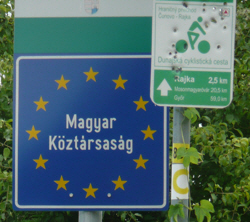
Thankfully, the bullet-riddled sign wasn’t representative of the Magyar attitude towards cyclists and we saw quite a few other tourists on the road (including 3 recumbents and a pack of 17 North Americans in matching kit who were doing a ride for charity) and the locals didn’t seem to mind us at all. Architecturally, Hungary felt similar to the Czech Republic and Slovakia. In the villages, about three quarters of houses were painted in muted beige/brown/grey colours and the rest were gaudily decked out in mint green, tangerine, lemon-yellow, acid lime and occasionally bright lilac. The overall effect was rather startling at first, a bit like being plunged into an architectural bag of Opal Fruits, especially if you got a run of 3 or 4 adjacent clashing colour schemes…but after a while it stopped being startling and was quite cheery.
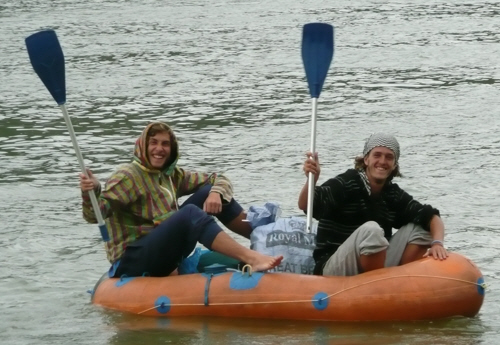
I hadn’t realised before, but Hungary is famous for its hot spas, and not just in Budapest. We treated ourselves to a night in a campsite adjacent to a spa and I dumped the clothes I hadn’t been able to wash in Bratislava into the washing machine, and then went for a swim with Keith followed by a nice soak in the outdoor hot pool. Unfortunately our spa-lounging was cut short by the appearance of a rainstorm…which got heavier and heavier and turned into a stupendous thunder and lightning display. We hastily dried ourselves and went to rescue our washing…and in the absence of either a tumble dryer or sunshine we bundled our clean but wet clothes into the tent and there we remained until 11 the following morning when we were forced out by the discovery that we’d actually pitched in a slight hollow and the tent was starting to float…..doh! We de-camped to the kitchen area where we spread out our sodden belongings and waited for the rain to ease…which it finally did just after lunch and we eventually got ourselves dried out, repacked and on the road by around 3.45pm. We didn’t get many miles done that day and, as the evening was dry, we decided to take advantage of a nice spot down on the bank of the Danube and eat our dinner watching a beautiful sunset. As we were checking out the potential wild campsite we met a couple of guys who were just packing up their own camp, and I’m really sorry they left us as they were great fun and for days to come we would grin just thinking of them. I guess they were in their early 20s, a Frenchman and a German who’d met in Israel, recognised they were kindred ‘live-for-the-moment’ spirits and decided to cycle back to Europe. They got as far as Egypt (we’ve no idea why they thought Egypt was on route between Israel & Europe – probably similar to Keith’s idea of going from London to the Black Sea via Scotland…) then ditched the bikes and I think then hitched back to Europe and were now making their way from Vienna to Budapest and then on to a rave near Lake Balaton. Since they’d had 10 spare days before they needed to be in Budapest they’d hit upon the splendid idea of paddling down that section of the Danube. Great plan, no? So, they’d bought a 2nd hand inflatable dinghy off Ebay for €15, bundled their scant (and now rather damp) belongings into a couple of rucksacks and a Royal Mail post bag (!), and set off. We laughed in disbelief at their tiny dinghy (they had to sit on their belongings, which filled the entire bottom of the dinghy, and there was only space for one of them to paddle at a time) and they proudly showed us its safety features, which seemed to consist solely of a built-in pump for easy re-inflation, which worked perfectly if one of them pinched closed the holes in the bellows whilst the other one pumped. They were probably the two most hilariously optimistic and friendly people we’ve ever met. Armed with wide grins and brimming with enthusiasm they left us with the feeling that absolutely anything was possible. I’d love to know what crazy adventure they come up with next. Bon voyage guys!
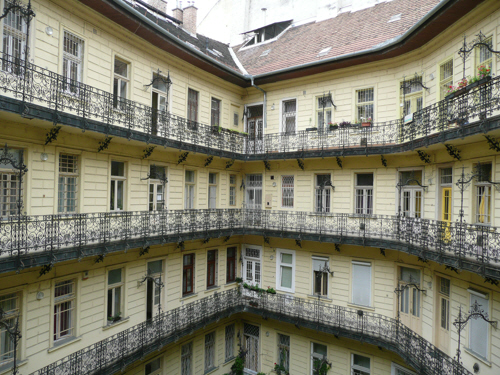
The guys’ joie de vivre kept us grinning as we pedalled on towards Budapest; somewhere we were both keen to visit. It didn’t disappoint. The architecture was grandiose and elegant, the wide boulevards were light and pleasant, and instead of our usual campsite arrangements we ended up staying in the luxury of an actual room, with beds! We’d been navigating towards the tourist office to get campsite details when we were hailed by a lady on a bike asking us if we needed a room. We declined and explained we were camping (even though the day was a rather damp one). She caught up with us again at the tourist office and Keith negotiated two nights in the city-centre room for the same price as two nights in the several-km-outside-the-city campsite. What a treat!
And to cap it all the other room in the apartment was occupied by two really nice American women who’d been touring on and off (mostly on) for over a decade and had a wealth of tips and tales (and bike parts) to share with us. We stayed up chatting with them all evening and came away with another wing mirror for the bike that exactly matched the one we’ve already got – an addition that Keith had been hankering after for some time. Thanks Addy & Gretchen.
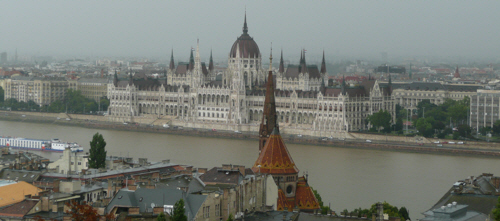
The next day we strolled around Budapest admiring the views and avoiding the occasional thunderstorm as best we could. We particularly liked a photography display outside the Parliament building about multi-ethnicity in the Carpathian basin: beautiful photography and some very clever, thought-provoking pictures. We walked for hours and in the afternoon were feeling rather “attraction-weary” so succumbed to the lure of the Tour-de-France, which we hadn’t seen any of in the preceding weeks and, as it entered the final mountain stage (stage 19 over the Col de Galibier with Alpe D’Huez finish) was set to be an epic battle. We found an Irish bar with a plethora of TVs and very few punters and spent a happy afternoon gasping, cheering and groaning at the telly as the battle unfolded….and then did it all again the next day too for the time-trial. Perhaps not the best use of two days in Budapest, but it was the right balance for us.
As well as the TdF, the other highlight of Budapest was the Trophy Grill….this splendid establishment provides the winning combination of an all-you-can-eat buffet with an all-you-can-drink buffet for the princely sum of £13.50 per person. The food was superb and we dined on duck with red cabbage, two different venison dishes, stuffed peppers, chicken with four cheese sauce, dumplings, fried potatoes, salads galore, delicious little toasts with foie gras, and all washed down with unlimited champagne. It was a hungry tourist’s gastronomic heaven and, as Keith wrote in his diary, “We ate ourselves silly and waddled home to bed.”
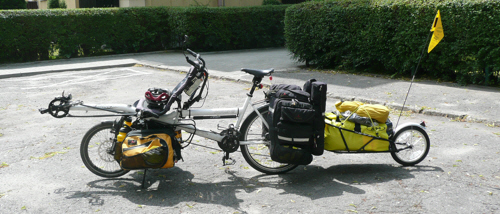
We reluctantly left Budapest and got back on the road, but couldn’t resist stopping at a bar the next day to watch Cav take his 3rd consecutive win on the Champs Elysee. As we watched the race I happened to glance out of the window and to my astonishment saw another white Pino with Bob trailer glide past. I nearly spilled my beer! Reaching the pub door I was in time to see them spin round and come back for a chat. It was a Swiss couple who were doing a 2 week tour and much bigger daily mileages than us…they were doing 130-240km a day compared to our paltry 50-120…and, it transpired, at a few kph faster than us too. Oh well….we compared bike set-ups and then they shot off into the distance and we returned to the beer and Tour coverage….but then saw them two days later in Croatia as they were fixing their 3rd puncture of the morning (after having taken a far longer route to reach the same point as us). We rode with them for a while and it was really funny seeing another long, loaded rig on the road…I can see why some of the locals give us odd looks now. Sadly the effort of trying to match their pace was just too much for me and we lost them as we entered Osijek, where we stopped for lunch and bought some brake pads, having sold one of our spares to the Swiss couple who’d somehow found themselves with two right pads and no left ones, and were in desperate need of a pad change.
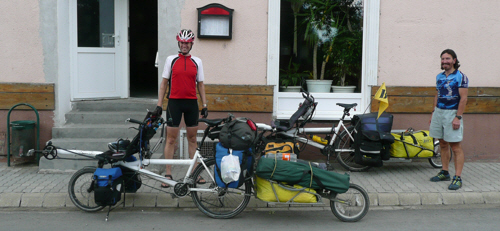
The border into Croatia was the first one where we’d had to present our passports since getting the ferry to France…and, although we didn’t know it at the time, we were the second Pino to have gone through that morning, our Swiss friends having preceded us. But the ice-maiden at the border was far too professional to engage in such pleasantries with us and was particularly terse with Keith who was too slow for her liking in removing his sunglasses.
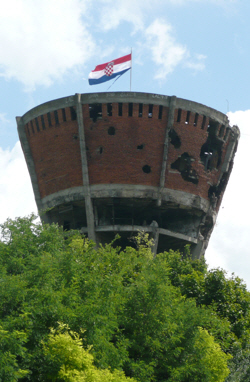
Once past the border guards the atmosphere became much more relaxed with Croatians smiling and waving at us, and obligingly filling our water bottles once we’d plucked up courage to stop and ask. The effects of the ‘90s conflict can still be seen in the shell-marked buildings in every town and village. There has been a lot of repair work done but it feels there’s still a long way to go before the visible signs of the conflict are eradicated.
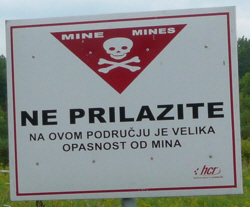
You have to be careful where you wild camp in Croatia. Not only is wild camping illegal (as it has been in almost all other countries we’ve been through so far – not that it’s stopped us) but there are still landmines left over from the conflict. These areas are marked with signs, but the extent of the danger zone is not particularly clear and in some areas the guidebook advises not to step off the road under any circumstances.
We eventually found a suitable track that led away from the main road and swung into a field of recently harvested barley. Perfect. There were a couple of fishermen at the adjacent stream but they didn’t mind us being there. We did, however, have a slightly anxious moment as dusk fell when I noticed a man with a gun walking away from us up the slope behind us. At the top he stopped, silhouetted against the evening sky. He lifted the rifle to his shoulder and slowly swung round until it appeared to be pointing right at us, but then, after a long moment, he turned away again and walked off out of sight. I’ve no idea what that was about.
We’d initially hoped to get through Croatia in one long day, but, of course, it turned into two days, and on day two we decided to take it easy and stopped for a leisurely pizza at a bar in the last town before entering Serbia. Some friends of the barmaid dropped in to chat to her, and to our confusion, we kept hearing snippets of a distinct Sarf London accent amidst the local banter. Eventually we interrupted them and asked where they were from…..and it turned out they were from Pimlico! The girl and her brother were born in London after their parents had moved there in the early 90’s because of the conflict, but they came to Croatia several times a year for holidays and spoke fluent Croation, but were flipping into ‘London’ for the benefit of her non-croatian-speaking boyfriend. We spent an interesting afternoon chatting with them and eventually crossed into Serbia at about 6.30 that evening, and very quickly found ourselves in quite a different feeling world. Croatia had felt very rural and relaxed, but on the road towards Novi Sad, Serbia felt quite industrial, dirty and overcrowded. There was litter alongside the side of the road, despoiling any piece of greenery that wasn’t already covered in dirt and dust from the large quarry/industrial site we’d ridden past, and the villages all ran into each other, making it hard to find any quiet spot to camp in. The first turn-off we tried, that on the map appeared to lead to a quiet area along the Danube, was packed with houses and people, so we headed in the other direction, up into the hills, and were accompanied for some time by two youths on bikes intent on showing off their skids and wheelies to us. We ignored them and pedalled on, hoping that at some point we’d come to and end in the houses and that they might eventually tire of following us. It took an age, but the boys did give up and we did at last come to a forested area. The road became a stony dirt-track and we bumped along keeping our eyes peeled for a suitable clearing to camp in. Suddenly there was a loud ‘crack’ from below us. B*gger. A spoke? The rim? But the wheels were still turning and we couldn’t see any obvious problem so I optimistically presumed it was just a stone pinging unusually noisily off something or other and kept going. A few minutes later we came across a clearing surrounded by the debris of (presumably) the local youths’ excesses. It wasn’t an ideal site, but it was midweek and already dark so we took the chance there’d be no-one out drinking that evening, and in any case the road was getting too steep and rocky to sensibly continue, so we pitched up, all thoughts of the strange loud cracking noise lost in the general faff of setting up camp in the dark and hoping no-one disturbed us.
The next morning we hurtled back down the stony descent, with Keith enjoying himself overtaking tractors hauling long trailers of logs from the forest. I wasn’t quite so happy and kept complaining that my crankset felt stiff and notchy. We stopped a few times but each time could find nothing wrong, and indeed the chain would seem to free itself and run smoothly….until we remounted and started pedalling again. After 20km we reached Novi Sad, and there, as we stopped at traffic lights and I continued to moan about my grinding cranks, Keith finally spotted the problem. Our frame had broken! A weld had failed where the tube running from Keith’s bottom bracket joined the flange below my seat (where the bike could be split for storage or travel). When off the bike, the crack closed up, making it hard to spot, but when either of us got onto the bike, the crack opened up, which put strain on the chain, explaining why I could feel a notchy stiffness when I pedalled. Well, that rather changed our plans for the day – and indeed the next 2 weeks – as we had to find somewhere to stay and arrange for a replacement frame to be sent to us.
We exchanged phone calls and emails with the shop where we’d bought the bike, and traipsed round Novi Sad looking for the cheapest accommodation, eventually settling on the excellent Hostel Sova (if you’re ever in Novi Sad then you won’t find nicer hosts than Mikki and Sanya). As we’d be there for a few days and would need space to rebuild the bike we opted for a private room rather than the dorm, but managed to get a bit of a reduction in the price due after telling the sob story of the frame and explaining our budgetary constraints. So, that was the Thursday, back in July! Blimey that feels a long time ago. Through our tardiness in selecting the hostel and providing the address, the new frame couldn’t set be despatched on the Thursday, but then on Friday there were apparently export forms or something to be filled in, so the bike didn’t even leave the German factory until Monday 1 August and we were advised it would arrive on Thu or Fri that same week. On Tuesday, Mikki, the hostel owner received a phone call from some agency requiring information for the import forms….he was not sure what info was needed, we chased it up and couldn’t establish this either. Wednesday and Thursday we waited. By Friday, Keith was tearing his hair out, phoning and emailing both the shop and the manufacturer, but neither was able to tell us anything about where our delivery was….so we resigned ourselves to a second weekend in Novi Sad. Novi Sad is a really nice city, but our budget can’t stretch to extended periods of paid-for-accommodation, so we were trying to amuse ourselves for minimum expense. We spent a lot of time planning what to do in Russia (and beyond) and also sleeping and reading and moaning about the bike. Eventually Monday 8th dawned and Keith resumed the ‘where’s the frame’ game. At around lunchtime, he established that non-residents, ie visitors to Serbia, like cycletourists, cannot receive parcels from outside Serbia as the customs people will not allow it. He tried to get the parcel redirected to either a bike shop or to the hostel owners instead of ourselves, but this was not possible either…we’re not entirely sure why. Finally, after going round in circles, we were told we would have to pick up the frame from the haulage company’s depot in Hungary. (We are now trying to find out who knew what when so we know who to vent our frustration on after 10 fruitless days in a hostel waiting for a parcel that it later transpired had been sitting in Hungary for a week, whilst we were still being led to believe it was on its way to Serbia. Grrr.)
Anyhow! Moaning wasn’t getting us a bike frame, so we gathered our kit, walked the bike to the train station and hopped on the overnight train back to Budapest. Well, when I say we hopped it was more of a grunting, straining kind of action fuelled by a paranoia that the train, which had been about 45 mins late arriving, would depart hastily with a piece of our gear still on the platform. But, with the help of a friendly Swiss guy we’d picked up at the hostel, we wedged the loaded trailer, four large panniers and the two halves of the tandem into the tiny area between the train door and the toilet and I then stood guard over our hoard whilst Keith and the Swiss guy headed off down the corridor to see which compartments had fewest occupants. A tall, amiable Serbian welcomed us and our accoutrements so we relocated (with some difficulty down the narrow corridor) to his compartment, where our baggage took up all the luggage space, one of the seats (front half of tandem) and part of the narrow corridor (rear half of the tandem). We then sat for a further 30 minutes until the train officials finally decided we could depart. Our Serbian companion said this was not uncommon, and indeed, every stop from then on was accompanied by 15-20 minutes of apparently pointless waiting around.
In due course, the guard came round to check tickets. We put on our best smiles. He did not. What were we doing putting half a bike on the seat?? We offered to pay (it was, after all, a bit cheeky of us to commandeer so much room) but after some moaning and grumbling that we couldn’t understand he shuffled off and left us in peace. Hurrah! Small victories feel so good, especially unsought for ones.
The journey itself was a combination of general discomfort, good banter, and strange happenings. Our Serbian companion was Lady Gaga’s biggest fan and also a former Serbia’s Got Talent contestant so he entertained us until his stop. We then sat and fidgeted fitfully until at a later stop we were joined by a shady looking woman who sat clutching her cheap, black briefcase until we all eventually dozed off at around 3am. When we awoke, at 5.30ish, the woman was gone. The briefcase remained. Perhaps she’d gone for a fag. Or to the loo. Hmmm. The train trundled on. The briefcase sat malevolently on the seat opposite us. I eyed it warily and tried to convince myself it was completely innocuous. Eventually, to our relief, at about 6am, just a few minutes before we disembarked at Budapest, the woman returned and reclaimed her briefcase.
So, we were back in Budapest, thankfully unexploded, and one rather long and arduous step closer to getting back on the bl**dy road to Russia before our visas expire. All that remained was to 1) find somewhere to leave the bike as we couldn’t face hauling it onto a further train to take us out to the suburbs where our new frame was (hopefully) awaiting us, and 2) to claim our frame. We strolled up into the city centre and spent an age hunting down a hostel that had been recommended to us. (We’d had to discount the apartment we’d previously used as we’d thrown away the card with the owner’s details. Damn.) Eventually we stopped for breakfast at Burger King and googled to get the exact address of the hostel we wanted, which made it much easier to find. Unfortunately it was full, as was the next, and the one after that was prohibitively expensive. Oh yes, dear reader, our arrival had neatly coincided with the “biggest music festival in Mittel Europe”. I was not impressed. Not impressed at all. I needed sleep and was losing patience…not to mention wasting time. Then Keith remembered the ‘biker campsite’ that our French friends Stephanie and Fabrice had recommended to us. A campsite would not be the ideal location for rebuilding a tandem, but would have to do. So we walked, Keith pushing the loaded tandem, for an hour from the centre of town to the campsite, which turned out to be absolutely fantastic so all was well there. Now, we just needed to get the frame. More walking, more train journeys (much easier without tandem and trailer), and then – oh joy – no taxi rank in the ‘burbs, so we had a hot, sticky, 45-minute stroll alongside a thundering dual carriageway to get to the industrial estate which housed the haulage company’s depot, where, to our delight, our new frame was actually waiting for us. Less to our delight was the discovery that it had been there since last week, at which point we were being told it was on its way to Serbia. Anyhow, it wasn’t the depot guy’s fault and he very marvelously arranged for one of his colleagues to drive us back to the campsite…..MUCH appreciated.
So, here I am, writing up the blog, and Keith has borrowed a bottom-bracket-extracting-thingy from the bike shop, so we’re all set for a day of bike building. We’ll let you know how we get on.
 threewheeling