Hami to Zhangye 1 – 10 November 2012

Sorry it’s been a while since the last post – the Great Firewall defeated us in Zhangye so we’re only able to post this belatedly now we’re here in Chengdu.  We’ll post our Zhangye to Chengdu tale as soon as we can…..probably early December.  Anyhow…here’s Hami to Zhangye:

Some people might call it cheating, but we say “Whoever said there were any rules to this travelling lark?”

As we’d approached Hami, both Keith and I had been feeling increasingly unwell with stomach cramps, nausea, loss of appetite and lack of energy, so it was with relief that we reached Hami and booked into a hotel.  For a day we thought we were feeling a bit better but then…well, let’s just say we appreciated the en-suite loo.  As Keith was the least ill of the pair of us he gallantly went in search of pharmaceutical succour whilst I languished near the en-suite.  So having arrived in Hami on the Thursday, intending to leave on the Saturday morning, it wasn’t until the Sunday afternoon that we actually set foot to pedal.  In the meantime, the weather had taken a distinct turn towards the frosty and we cycled past strange patches of glistening brown desert, which, upon closer inspection this turned out to be snow that had fallen during a sandstorm.  (It’s remained cold enough since then for the snow to remain on the ground, with temperatures falling below zero every night and barely reaching double figures even on the sunnier days…brrrr!)

We couldn’t find the old 312 road as we left Hami so were stuck on its replacement, the tedious G30 dual-carriageway, with lots of trucks and little to see but boring gravelly desert stretching away into the ever-present smog.  We were feeling pretty feeble and progress was slow, so on the Monday, when an English-speaking Chinese man stopped for a chat and to see if we wanted a lift we were sorely tempted.  But he was only going a further 60km down the road so it didn’t seem worth it.  We soon began to regret our decision though as the kilometres felt like they were taking forever.

The trailer going up

Ten kilometres later, when a truck slowed alongside to get a better look at us, Keith didn’t hesitate.  Out went the thumb and on went the hopeful puppy-dog face.  And it worked!  The truck stopped and so did the one which was in convoy behind it.  Within a short while our tandem and trailer were strapped securely on top of the cargo of the first truck, our front bags were in its storage compartment and our rear panniers and solar panel were in the storage compartment of the second truck.  400km disappeared in a matter of hours and our lovely driver and his wife fed us apples and pastries on the way.  We offered our driver some money, but he wouldn’t accept it, preferring an English fiver as a memento.

Hardcore French Michael had left Hami promptly on the Friday (into the snowy sandstorm…or sandy snowstorm, whichever way you prefer it) and Aussies Laura and Ash had left on the Saturday once the storm had cleared, so we’d kept our eyes out for them, wondering whether we should shout and wave as we passed or keep our heads down in shame, but we saw neither so didn’t have to make that decision.

Back under our own steam and feeling much better we trundled into Jiayuguan, which at one point was the border between China and Central Asia and gave us our first glimpse of one of the fortresses along the Great Wall.  But it was mid-afternoon on an overcast, cold day and we wanted lunch rather than tourist attractions…and in any case the fort wasn’t the original but had been rebuilt more recently, so we didn’t stop but carried on into the town centre and enjoyed a delicious lunch, and then bought some fairly decent maps in the bookshop.  Sensibly scaled maps (something with a scale better than 1:1,000,000) have been hard to come by in China despite visiting bookshops in every city and town we go to, but Jiayuguan was a winner.

The fort at Jiayuguan

We’d hoped to camp between Jiayuguan and Jiuquan, but the 20km between them was all industrial and there was nowhere suitable, so we ended up going through the fairly large city of Jiuquan as night fell and eventually found some wasteground on the south side of the city next to the highway.  In the morning we went back into Jiuquan to buy a new SIM card for our mobile phone as ours had ceased to function upon leaving Xinjiang province, and, to our delight and astonishment bumped into Laura and Ash, who’d had the same cunning plan as us and hitched for 200km.  We’d all have preferred to ride all the way through China, but with visas only coming in 30 day chunks (of which you lose 5 days as you need to apply for an extension in good time and it can take that long for an extension to be issued….or indeed they may choose not to issue one and you need to leave time for plan B) and the continuing cold weather, we’d come to the conclusion that we’d had enough of slogging through endless desert on the dual-carriageway, never having time to see any of the sights, and in all likelihood facing the prospect of having to get a lift anyway later in the trip when we’d perhaps be missing more interesting sights than the desert (of which we’ve already seen plenty thank you very much!).  And so what Ash dubbed ‘Operation Enjoyment’ was put into play and we returned to being tourists instead of relentless cycling machines.  We rode one final day on the highway and then rolled back onto the old 312, riding through small towns and villages, watching the desert change to agricultural land and back again, and excitedly making plans to see some tourist attractions in the town of Zhangye.  The 312 is not a particularly busy road so for much of the time we were able to ride side by side chatting, and our decision to stop in Zhangye proved to be a very good one as snow began to fall just as we rolled into town.  It took us a while to find a hotel as many won’t accept ‘foreign friends’, but with the help of a friendly local called Chen Gang (who spoke good English and accompanied us to two or three hotels) we finally found a suitably cheap and “foreign-friend”-friendly one.

Zhangye Pagoda

That evening, after the usual round of washing clothes and catching up on emails that seems to take up the bulk of any hotel stop for a cycle tourist, we went for a stroll around the sights of Zhangye in the bitter cold and then to a small restaurant for  dinner.

We have a number of strategies for ordering food.  If we can’t find a place with an English menu then we look for somewhere with pictures on the wall, and failing that somewhere with plenty of people eating and then we just point at other diners’ dishes, and failing that we just take pot-luck with the menu, or sometimes we’ll employ a combination of the above.  Most of the time we’ve done well and ordered some delicious dishes, but once what we’d hoped was a vegetable dish turned out to be just a massive plate of fried peanuts.  Tasty but not what we were really after.  We took most of them in a doggy bag to nibble on the road and ordered something else.

Team Oz, feasting

The next day the snow had stopped falling but everywhere was blanketed and it was very cold.

Ash summed up what was on everyone’s mind

With Operation Enjoyment in full swing we paid for a second night at the hotel and the four of us caught a bus for sixty increasingly slippery kilometres out to Mati Si and the Horse Hoof Monastery.  The bus normally stops at a junction close to the village of Mati He where you either take a taxi the final 10km up to Mati Si, or wait for the local minibus to fill up and take you there.  But as we were the only people likely to be going up to the monastery that day our bus driver offered to take us up for an additional 100 yuan (about £10).  Keith beat him down to 50 yuan and established from a conversation with another passenger that the last bus back to Zhangye would be leaving from the junction at 5.30pm. How we got back there from the monastery would be up to us.

7km from the junction you enter the ‘scenic area’ and have to pay 35 yuan for the privilege and then another 35 to enter the monastery itself, but we were only charged 55 for the two tickets, perhaps as a concession to the cold weather.

Mati Si high street

Mati Si in the snow is beautiful.  The bus dropped us in a pretty but deserted street of decorated houses, from where it was a short walk up the hill to the Horse Hoof Monastery itself.

The temple at Mati Si

Between 500 and 1500 years ago a series of Buddhist temples were carved into the mountain.  Each little room has a statue in it surrounded by paintings, carvings, incense sticks and offerings ranging from grapes to money. Brightly painted balconies cling to the cliff face and link some of the rooms, whilst others are accessed up steep and unevenly carved stairs within the rock itself.

The guardian of the temple

The only other people we saw were a solitary monk (who confirmed we were heading in the correct direction from the village) and the man who checked our entry tickets (whose only companion was a large chicken).

Ash going up

Tamar on a painted balcony

Looking back from the temple

Laura coming down

After exploring the temple, and in the absence of any other mode of transport, we walked the 10km back down to the junction, to arrive just in time for the 5pm bus, which Keith sprinted for and which then waited for the rest of us.  One of the passengers was a man Keith had been speaking to on the morning bus and who’d told us about the last bus back.  To our confusion the ticket collector wouldn’t take any money from us, and as we got off the bus in Zhangye we discovered that our fellow passenger had paid our fares!  We thanked him but insisted that we must repay him, but he just smiled and backed away, becoming lost in the crowd.

Although some people here still seem quite rude, jostling and pushing us out of the way to get a better look at the bike, we’ve also met a lot of lovely people, like the bus passenger, the people who’ve given us lifts on the road and Chen Gang who helped us find a hotel.  Quite frequently people who can speak a little English will give us their phone numbers and insist we call them if we have any difficulties, and in Hami a radio presenter gave us four bottles of water and welcomed us to China.  A lady at a petrol station where we were buying some water, shyly whispered “Welcome to China!” before hiding her face behind her hand and giggling with embarrassment.  It more than makes up for the more frustrating experiences.

China is a fairly cheap place to travel in, but our budget’s taken a bit of a hit since we got here as we’ve been shopping:

In Aksu:

  • Two new helmets – Keith’s bit the dust in the truck from the Chinese border to the immigration control centre, and mine had suffered some cracks last year when the bike fell on it (blown over on a windy day), and was also not quite the right shape to comfortably fit my sun visor plus a hat or a hood beneath it.
  • A 2m square silver foil sleeping mat that extends almost the entire length of our inner tent and about 25cm up the side walls.  It’s only 2mm thick and therefore doesn’t really disguise bumpy ground too well, but it does make the ground feel less cold, which is particularly welcome partway through the night after our mats have slowly deflated.  I wouldn’t say the sub-zero nights are comfortable….but they’re at least bearable now.

In Hami:

  • A new camera – replacing the one I dropped, which we tried to get repaired in Turpan but was beyond redemption.  We’ve gone for another Lumix so that the controls are familiar enough for me not to require another 3 year learning curve but this model allows more manual setting of shutter speed and the like so Keith is very happy.
  • Warmer gloves for Keith’s cold hands.
  • Warm socks for Keith
  • New trousers for me – replacing the ones that had sun-bleached from a lovely blue-grey to a patchy lilac (why can’t manufacturers of outdoor clothing use a fabric that can withstand being worn outdoors?) and had also become rather too loose on me. (Grin!)

Keith’s blog addition:-

An interesting thing about China is that despite it’s being 4400km (2725 miles) from east to west, “officially” it is all in the same time zone, that of Beijing (GMT +8hrs).  Beijing is in the east of the country, and GMT +8hrs, suits it well, but when you are about 3000 or 4000kms west of there, it means the morning sun doesn’t rise (at this time of year) until about 8:30am, and then doesn’t set until about 6:30pm.  So if you have a habit of using the sun for rough navigation, then the midday sun is still well short of being south, and it can sometimes get a little confusing.  Also, in the far west of China (Kashgar for example) they have an “unofficial” local time which is 2 hours different from Beijing, but as you travel east, the use of unofficial local time gets less and less until you reach Turpan, where they just do everything on Beijing time.  This caught us out a couple of times, and we nearly got into trouble for not checking out of our hotel room on time, and restaurants seemed to close very early, until we realised we now needed to fully adopt Beijing time.

Another point of interest is the currency – the Yuan.  There are a few coins in circulation, but it is really unusual to actually see any.  Nearly always, all of your money is in paper notes.  There are roughly 10 Yuan to the GB-pound at the moment, and the notes start at a value that is equivalent to 1 pence (or 0.1 of a Yuan).  There is also a note for 0.5Yuan, then 1, 5, 10, 20, 50 and 100 – so equivalents to 5p, 10p, 50p, £1, £2, £5 & £10, all in paper money.  So when you’re doing the shopping, you are constantly taking this fistful of notes from your pocket, also, everybody seems to be trained on how to handle large fistfuls of notes and they all count your change out in a very specific manner, folding the notes over their fingers to count them back to you – we haven’t mastered this yet.

And back to Tamar…

In addition to the baffling road rules mentioned in the last post, we’ve also noticed that the Chinese are fond of decorating their cars’ rear windows.  It’s most common to see it on taxis, but a fair number of private cars will have either a speedometer painted across their rear window or a map of a racing circuit.

And finally the other particularly Chinese thing we’ve come across is the face mask.  We think it’s in response to the appalling pollution.  About 30-40% of the women and a smaller proportion of men, particularly in cities, wear facemasks looped over their ears.  Some are very plain – the men’s are usually just white or black – but a lot of the women and children wear coloured ones adorned with an array of spots, bows, sequins, stripes, flowers, checks and/or cartoon animals.

Kashgar to Hami 14 October-1 November 2012

A new country means new road rules…and we’re finding China’s a bit baffling.  Here’s what we’ve surmised so far:

  • If you have fewer than four wheels you can travel in any direction up any carriageway (including the fast lane of a dual-carriageway!), or indeed the pavement.
  • If you’re overtaking anything, sound your horn, repeatedly, even if the thing you’re overtaking is stationary and just sitting having a snack at the side of the road.  If you have an air horn all the better.  Lean on that sucker!
  • If you can’t hear a horn in the immediate vicinity (something of a rarity in any urban setting where the blaring simply becomes an easily ignored background noise) then consider it safe to amble across the road, pull out of a junction, change lanes or just stop in the middle of the road.  No need to bother yourself looking around beforehand.  (We have discovered that Keith can do a pretty convincing impression of an air horn when called upon)
  • If lights are green for pedestrians, don’t worry, as a car/moped/bus/lorry driver you and your horn have priority.  Feel free to scatter unsuspecting newcomers like skittles.
  • Use of indicators is strictly optional.
  • Number plates, whilst a popular addition, are by no means compulsory.
  • It’s perfectly OK to slow to a crawl straddling both lanes of a dual carriageway in order to get a better look at the Pino.  Don’t worry about the heavily laden and badly-maintained truck that’s right behind you (blaring his horn)…he’ll probably locate his brakes before he punts you up the exhaust pipe.  (Sadly this wasn’t an isolated incident.  It’s pretty much a daily occurrence.)

Working out the Kashgar traffic rules.

And that’s just the traffic.  We’ve also got a completely new language to try to learn (so far I’ve expanded my vocabulary of three words to about five, but Keith has been diligent and listened to audio lessons whilst pedalling, and can now tell people quite confidently in Chinese that he can’t speak Chinese).

Uyghur butcher, Kashgar Old Town

To make matters even more interesting, Xinjiang province is not just Chinese, it’s also got a sizeable Uyghur population who speak a Turkic language more closely related to Kyrgyz and Kazak, but written using the Arabic alphabet rather than the Cyrillic we’ve been used to for the past few months.  So when reading road signs we have a choice of Chinese or Arabic…and our map only has the larger towns and cities marked in Chinese characters.

The Uyghur/Han differences are most apparent in cities, particularly in the west of the province, where the old town areas are predominantly Uyghur: winding streets with small traditional shops, intricately carved brickwork buildings, smoky shashlik stalls, bustling bazaars and minareted mosques.

Beautiful Uyghur carved brickwork, Kashgar Old Town

Some Uyghur women cover their heads with a knitted brown shawl, lifting it occasionally to inspect market produce.

The new town areas are predominantly Han Chinese: bright lights, modern buildings, Western-style shops and loud music blaring from every frontage.  Another feature of the Han areas seems to be a keenness for security.  Lots of shops, banks, hotels and even some petrol stations make you walk through body scanners upon entry, and lined up next to the security desk you’ll find a row of riot shields, tin helmets and truncheons.  Mind you, we’re not too sure under what circumstances they’d be used as the hotel security guard in Aksu was snoring soundly with his head next to his tin helmet on his desk, and didn’t stir when the body scanner bleeped us through.

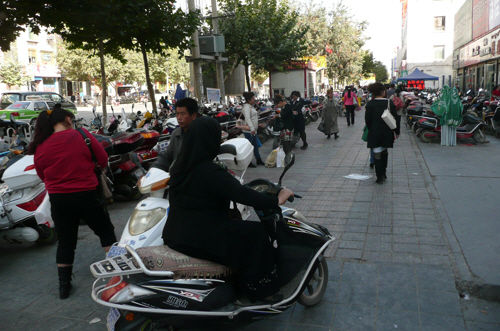
Ubiquitous to both Han and Uyghur areas are multitudes of scooters and threewheeled contraptions that have the rear end of a flat-bed truck and the front end of a moped.  The scooters are almost all electric and thus sneak up on you silently until their horn suddenly adds to the general cacophony around you, and, to be honest is quickly lost in the multitude of other horns, shouting stall-holders, fire-crackers, multiple competing shop stereo systems, public announcements on large TV screens, talking calculators (seriously!) and the ever-present, quintessentially Asian sound of men hawking and gobbing unashamedly in the street.

Scooters in Kashgar New Town

The stealth approach of the electric scooters is enhanced in the evening.  As the sun sets, scooter headlights remain resolutely off, presumably to prolong battery life.

We’ve been putting in some big days since leaving Kashgar as our visas are only valid for 30 days and we wanted to get at least half way to Chengdu before applying for a renewal.  A fairly typical day involves the alarm going off at dawn, a few minutes of stretches and sit-ups and the like followed by an unashamedly leisurely breakfast, then packing up our kit and hitting the road.  We pedal until lunch, which is a bowl of laghman (pulled noodles with a topping of chopped meat and vegetables) at a roadside cafe/truck-stop, accompanied by endless cups of tea from the huge teapots that are always on the table and replenished often.  Then more pedalling until about 20-30 minutes before sundown when we start to consider where we’ll sleep for the night.  Campsite selected, we pitch as the sun sets and the temperature heads towards zero, and then retire to the tent to prepare dinner.  We’re usually in bed by 9pm (me fully clothed and wearing down booties and down jacket inside my down sleeping bag….and still plagued by cold toes).  And then we get up and do it all again.

Every 3-4 days we hunt out a supermarket to re-stock on exciting new things to eat.  This is sometimes easier said than done as they’re often hidden downstairs in a department store, and even once you’ve located them you can’t easily get in as the most obvious entrance is actually the exit and you have to walk round the store, sometimes having to go upstairs and through the clothes section, before finding your way to the supermarket entrance.  Once in though, Chinese supermarkets are brilliant.  We have no idea what most things are, but after the frankly pitiful selection of vegetables in most Russian, Kazak and Kyrgyz shops, the range of fresh or dried fruit and veg in China makes us grin from ear to ear.  Green beans 50cm long, a whole host of dried or fresh funghi at bargain prices, squashes, leafy things,  bulbous, stick-like things that we have no idea what to do with (and haven’t dared buy them yet) and pieces of bamboo that you strip the bark from with your teeth and then chew the fibrous inner to release the sweet sap.  A veritable vegetable cornucopia.

The downside to the shopping experience is that we can’t enjoy it together as we continue to be plagued by crowds (usually Uyghur) who are incapable of looking without touching, pulling, prodding and yanking.  Sometimes it feels similar to driving through a safari park where the monkeys jump on your bonnet and try to rip the windscreen wipers off.  And the Pino isn’t the only target.  I was guarding the bike against the worst excesses of the stony-faced rabble when I felt something nudging against my leg.  Looking down I discovered a man giving my calf a thoughtful prod like I was a prize heifer.  Despite being somewhat affronted I was, of course, still vain enough to tense my muscles a little, which no doubt was the clincher that prompted him to give a nod and a thumbs-up to the expectant crowd.  Very weird behaviour!  It’s like people here are permanently pissed and uninhibited, but without the amiable beer-grin.

Thankfully, not every stop has been like that and we’ve also had some much nicer experiences with people smiling in a friendly fashion, looking to us for permission as they approach the bike, and even telling other people off on our behalf if they’re being too forward and presumptuous.

Scorpions…

The most interesting shopping experience to date was probably in Kashgar, where the markets sell pretty much anything you could possibly want even in your weirdest fantasies.  Live scorpions and a bowl of big fat frogs sat next to stalls selling mouthwatering fresh figs, and whole avenues were devoted to the sale of hats in every shape and style conceivable.  It is not possible to buy duct tape though.  The closest thing we’ve found so far is a roll of some silvery shiny stuff.

…frogs…

…delicious fresh figs….

…things on sticks…

…you can even by a kid in a box at Kashgar market.

The Impromptu International Bike Club, formed on the Kyrgyz-Chinese border, disbanded in Kashgar as we had differing itineraries, but French Michael and Aussie tandemists Ash and Laura were heading our way, albeit it leaving Kashgar a day ahead of us.  We swapped mobile phone numbers and over the next fortnight met up frequently, either by chance or design, at lunch stops, overnight camps, and occasionally a hotel (in Aksu where we hadn’t intended to stop but where the Fr-Oz contingent were holed up awaiting a new rear wheel for the tandem as the hub had died a death.)

Meerkat on the lookout for scorpions.

We took the northern route across the Taklamakan Desert, taking the 314 from Kashgar, through Kucha and Korla to Toksun, the X050 to Turpan and then the 312 to Hami.  At least that was the plan.  From Kashgar to Aksu the route was plain sailing and the 314 ran alongside the building site that is to become the new highway.  After Aksu, the new highway is completed but the old 314 is still in existence…for about 60km and then we arrived at a junction with a choice of ignoring the ‘no bike’ signs and sneaking past the toll booths to join the highway (a dual carriageway with barbed wire fencing along either side) or heading up the 307 into the hills…which is what we reluctantly did, adding a number of kilometres to our route and a few hundred metres of climbs.

Our reluctance turned to delight though as the scenery became more and more spectacular with beautiful orange striped rocks in interesting shapes lining our route and spectacular valleys spreading before us at the top of the final climb.

Nice rocks on route 307

What a view to wake up to!

And when we finally dropped down into Kucha, it was only a short 4km detour to go and see the Kezilgaha Beacon Tower, a 2000 year old watchtower from the Han Dynasty.

Kezilgaha Beacon Tower

Laura, Ash and Michael had ignored the no cycling signs and barriers and taken the highway without incurring the wrath of the police, which gave us the confidence to do the same upon leaving Kucha.  The road surface was good and the traffic not too heavy (albeit rather heavy on their horns) and on the days when we had a tailwind we could cruise along at 25-30kph quite happily.  It did get a bit boring though, so, if after leaving the highway for a lunch-stop, we found that the old 314 was still around we’d ride on it for a while, watching the donkeys with carts trotting to market and seeing chillies and sweetcorn drying in the sun.

Sweetcorn drying at a disused petrol station

Chillies drying just outside Kucha

A steady stream of donkey carts and motorized 3-wheeled contrivances on their way to market

The old 314 road wasn’t a reliable route though and often ran out, dumping us back on the highway whether we liked it or not.  Usually the guards just waved us through the barriers, but a couple of times they called us to a halt.  Our strategy, which worked both times, was to beam at them, show them the map and ask how to get to Turpan, at which point they would helpfully point us onto the highway and we thank them and be on our way.

We had a couple of days with headwinds, and one fierce sidewind that whipped up the sand and almost blew us off the bike (especially when a lorry came past, sheltering us and then dumping us into the wind’s teeth again) but for the most part we’ve been pretty lucky with the weather, even clocking up 156km in 6hrs20 one day…..something that would never occur without meteorological assistance.

Some days the view was rather unvarying

The route’s been mostly flat, but with a few notable climbs, particularly the one that crested about 50km before the town of Toksun down in the Turpan basin, which is the second or third (depending on which guidebook you look in)  lowest place on earth.  The climb was not particularly steep, but was about 30km long and rose to a high point of 1800m, where we camped as dusk was falling.  The next morning the 50km into Toksun (at around -150m) took just a fraction over the hour.  Lovely!

Where grapes become raisins, just outside Turpan.

A minor road took us from Toksun to Turpan, through small villages, empty desert, and an unexpected damp and verdant patch.  Turpan itself is surrounded by vineyards and brick drying houses where the grapes are turned into the sweet moist raisins that the area is famed for.  It’s a small but pleasant city with a couple of streets attractively shaded by grape-vines and on the outskirts is an 18th century mosque with a tall Afghanistan style minaret.

A Turpan street festooned with vines

18thC Afghan style Emin Minaret, Turpan.

There was a beautiful sweet honey-like scent in the air on some of the streets, which Keith tracked down to some large blocks of orange crystal with a mossy green edge to them.  Intrigued we bought some and it turned out to be a sort of sweet sugar-rock that the seller chipped into more manageable pieces for us using a mallet on a large metal blade.  Perfect fuel for the hungry cyclist if you can only get your teeth into it.

Probably not very good for your teeth in either the immediate or long term future.

Bored of the dual-carriageway, we left Turpan on a minor road that wasn’t on our map but threaded its way in a generally easterly direction through small villages and past acres of greenhouses.  All was going well until we heard an ominous crack and discovered the weld holding the bottom tube to the flange where the bike splits in two had failed….for the third time (first time this trip, but it happened twice on our trip last year and we’d hoped for more from our third frame after assurances from the manufacturer that the problem had been resolved).  We reinforced the bike with a webbing strap and rolled slowly and carefully for a short while before finding somewhere to camp for the night.  We were near a village so the next morning we rolled in and quickly found a welder (which are in plentiful supply in China if you want steel welding), but sadly, welders who can weld aluminium are a somewhat rarer breed than those that can do steel, and after being turned down by two or three we were advised to either return to Turpan or head on to Shanshan.  To get to the highway we had to go up over a small climb, which we walked the Pino over to avoid any big strains on the frame, and when we reached the highway we made up a couple of signs and stuck our thumbs out.  It didn’t take long before a small car stopped.  The driver couldn’t take us anywhere but he could speak English and wanted to help.  A few minutes later a flat-bed truck stopped and our new Chinese friend explained our predicament to the driver, who said he’d take us to somewhere just the other side of Shanshan where he assured us they could weld aluminium.  So off we went.

The junior welder was highly enthusiastic and assured us it was a five minute job.  He did not inspire confidence.  First of all he tried to start welding without grinding out the old weld first.  He then tried to grind out the old weld using the sander meant for roughening up truck inner tubes prior to patching, and eventually, after he got nowhere fast with the sander, his boss came out and provided him with an angle-grinder, but he did such a terrible job that his boss took over…and informed us that the frame was aluminium (which of course we knew and had already told his assistant several times) and, to our complete lack of surprise, he said he couldn’t weld aluminium.  The boss then drove Keith off to another place where, eventually, the correct welder was located, the bike was repaired and we were back on the road to Hami.  The old 312 road didn’t last very long before dumping us onto the highway again and we stayed on it up the long climb out of the Turpan basin and then after a brief descent up again over a second ridge of hills and then down into Hami where we re-grouped with Michael, Laura and Ash, and, somewhat sooner than expected, have acquired some new Chinese visas.

The internet is full of horror stories about Public Security Bureaus (PSBs), which are the places where you get your visa in China.  They often take 5 working days to process your application, sometimes require you to go to a particular shop to have a photo taken and put on their system, sometimes require you to have a Bank of China bank account with a particular amount of money in, and sometimes just refuse to do it and tell you to go to the next town.  If your visa runs out, then the problems multiply.  Michael, Laura and Ash had been to the Hami PSB earlier in the day as they arrived here before us, but as the PSB’s English-speaker wasn’t there they were told to come back tomorrow (Friday).  We decided to trot down ourselves anyway, expecting to be told the same but wanting to show our faces anyway to make sure that we didn’t just go on Friday to be told to return on Monday (stranger things have happened if you believe other reports).  To our surprise, the English-speaker was there and processed our paperwork there and then.  Even the best reports we’ve read of other people’s experiences have only managed a 24 hour turnaround.  We were in and out in 20 minutes!

This sounds great, but it’s actually a little inconvenient.  Our old visas were valid until 7 Nov, ie next Wednesday…but the PSB won’t start the new visas from the expiry date of your old visa, they start on the day they are issued….but because it might take up to 5 days to get a new visa, and because you need to leave time for plan B just in case, for some reason, they won’t issue you a new visa (and you need to leave the country or try again elsewhere), it’s best to start applying a few days in advance and accept you’ll lose a few days of your old visa.

As we were not expecting to get our visas on the same day and also because we wanted to spend a full day here in Hami doing things like buying a new camera (I dropped ours from a moving tandem and whilst it still take photos the screen doesn’t work so you have to guess what you’re aiming it at, and our attempts to get it fixed in Turpan came to naught) we booked into our hotel for two nights.  And then got our new visas less than an hour later!  So we’ve lost 6 days from our old visa and have a new one that starts today.  It’s going to be incredibly tight to get from here to Chengdu in less than 30 days (which is where we hope to renew our visa for a second time) and we’re already losing one day of our new visa by spending it in Hami.  But we guess it’s better to at least have the visa and not be worrying about plan Bs…at least not for another few weeks.

And finally….here’s some other pics of things we like:

The spirit of the Reliant Robin lives on in Xinjiang

A truck, on a truck, on a truck….

Modern-day Uyghur falconry

Chilli sellers just outside Aksu

Giant nan bread in Kucha

Camping in a diversiform-leaf poplar grove