
I’m writing the blog entry this time (I being Keith) – just to keep my typing skills alive … and have a little rant or two … Throughout our trip so far (6,800kms to date but currently halted, but more on that below) cycle-paths have been a regular (if not constant) bone of contention between Tamar & I. That might seem odd since we’re touring on a bike and surely cycle-paths would be a good thing, but have you any idea how many countries seem to think that if any manner of cycle-path is provided, that therefore means that bikes should be banned from the nearby piece of road? A very worrying number of nations now have signs up banning bikes from normal roads where they have a bike lane nearby, and if that government trend catches on in the UK – we’re all stuffed and may as well sell our bikes now.
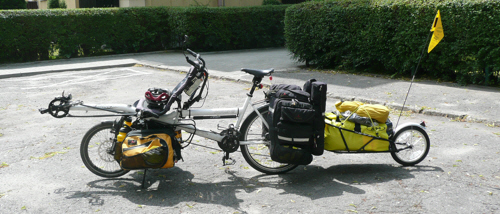
You may have noticed that our bike isn’t the most nimble of machines (see picture of bike complete with new BOB trailer which is behaving well after 1,000 kms so far) – it’s not your average racer or mountain-bike after all and when it comes to bouncing it up & down kerbs, and getting it around various bits of street furniture on the pavement, at speed, it gets really frustrating having to use these cycle-paths when all you’re trying to do, is get some decent distance covered in a reasonable amount of time. If you want safe routes for 10 year olds to cycle to school on, or for various folk to ride their bikes to the shops on, then cycle-paths are great, but in my opinion, when you’re wanting to get somewhere with a fully loaded touring tandem – committing yourself to a cycle-path, can be a risky business – it’ll end somewhere unexpected, or expect you to cross to the other side of the street at whim, or get you to stop at every T-junction you go past. All in all, your passage is much more hampered than that of the car travelling in the road just next to you … where you used to be allowed to ride your bike.
Since leaving home in April, in the UK cycle-paths were regularly hopeless, but yet we did follow quite a few of them. We had to strip our bike of luggage and lift the entire kit above our heads to get it through anti-motorbike gates at least 3 or 4 times and even just the chicane type gates, are normally built much too close to each other to be able to get through with a tandem (even without a trailer).
In France, a number of the long distance trails were actually very good, and being built on either disused railway lines, or on top of river flood defence dikes, they ran really well and allowed you to keep a good speed going, but in town-centres, where they put you up & down kerbs, and round lamp-posts and flower-pots and other street furniture, they were just a nightmare. But in one small town, where I wasn’t using the cycle-path (for the very reasons above), at a set of traffic lights (where I’d stopped at the red light!!) a policeman jumped out of his car behind us, ran up to us and gesticulated that we should be on the cycle-path up on the pavement. I was fuming with the copper, and Tamar was fuming with me for fuming at the copper. I was back on the road 5 minutes later.
In Austria, the drivers were terribly polite and wouldn’t overtake you until they could see that the road ahead was clear for at least 5km – but this inability to overtake safely & swiftly, led to traffic sometimes building up behind us and not everybody delayed, would be polite. And of course when we first arrived in Austria we had the conversation with the driver who told us that it would be better for us if we weren’t on the road as we might not hear him approaching in his hybrid car – surely the road is big enough for both of us?
Slovakia & Hungary both had stretches of normal road, where bikes were banned as they had provided a bike-path, but every now and then the bike path would swap to the other side of the road so you’d have to stop, cross over, and then work really hard to get the bike back up to cruising speed – and sections were often quite badly affected by tree roots and rough surfaces are not going to prolong the life of our bike or the wheels on the bike.
The Czech Republic started off quite good where a number of the roads had a healthy size of well-surfaced hard-shoulder, but where they did have cycle-paths running along the pavement, every time the cycle-path met a side-road or gateway to an industrial unit, the cycle-path just stopped. There was one long section of road however where bikes were banned and we had to use the cycle-path for about 20 or 30km, where it was a mix of dedicated cycle-path and part round the back-streets of about 4 or 5 villages with kids playing football on the streets and parents teaching their little kids to ride their bikes on the cycle-paths, while we’re trying to maintain 20 to 25kph and cover 100kms in the day. Poland didn’t bother with either – hard-shoulder or bike-path.
And in all of the countries, direction signage on cycle-paths has been really poor, so if you want any-way decent signage, you need to be on the road with the main traffic.
Either way – when you see the way that UK local authorities boast about how many miles of cycle-path they have created, if we (as cyclists) are not careful, it won’t be long before they force us to use them, regardless of how good, bad, safe (or more frequently dangerous) they are.
Anyway … rant over … sorry!!
Other national differences
Supermarkets are great, but every time you move to a different country, even though you go back to the same retailer, there’s no telling what they’ll have on the shelves. When we left France, we didn’t see their supermarkets again until we got to Poland (Carrefour, InterMarche & Auchan). Lidl has been a great constant in many countries, but now that we have arrived in Serbia, we may have seen our last Lidl. And Lidl as it happens, are quite up-market in a number of countries, with in-store bakeries & all sorts – and fresh croissants for about 25p!! The whole way through France we hardly ever ate a croissant as they were too expensive at nearly €1 each, but we had croissants with breakfast nearly every day in Germany & Austria courtesy of Lidl. Where we were staying in Poland, there was a supermarket called “Biadronka” (means Ladybird in Polish) just across the street, but it’s definitely a few notches down from Lidl. Tesco have reappeared with supermarkets & hypermarkets in many towns in the Czech Republic, Poland, Slovakia & Hungary and it’s remarkable how many items they sell with the standard English language front label on, but on the back of the packet, there’ll be a stuck-on panel with usage instructions in the local language. The Tesco hypermarket in Poland, had given the whole side of one normal aisle, to vodka!! … same amount of space as you’d normally see given to wine. And in France, standard muesli was really expensive and actually hard to find, but Lidl is the most reliable for muesli, with a 1kg bag for about £1.50. Beer has been quite cheap in all countries since we got to Germany, but for a drink with our dinner in the evening, we prefer a bottle of wine but we’ve tried to set a budget of about £2.00 for a bottle which has actually been quite easy to stick to as there are actually quite a few bottles in that range which taste quite good – Lidl’s Vin-de-Pays D’Oc Merlot has been a very reliable tipple for about £1.70. Yet while beer & wine have got cheaper & cheaper, fruit juice just gets more & more expensive – in any supermarket since France, it’s almost impossible to get a litre of fruit juice for less than €1.
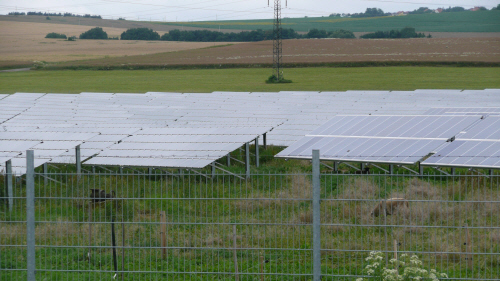
Solar panels or use of solar power has been very interesting through the different countries. France was a bit like the UK, where some houses have 4, 6 or 8 panels on their roof, but it’s still a bit unusual. The Germans however have a very different approach and it’s clear that it’s a government initiative as loads of big buildings and especially farm buildings have the entire roof covered in panels – by a long way, Germany was the country making the most of solar energy. Austria as a bit more like France & UK, while in the Czech Republic we saw fields that had been given over to the harvesting of solar energy – the field would be FULL of south pointing panels (see photo) angled at about 45o and some of the fields would also have sheep or cows in, so double purpose and the animals also get shaded from the sun! Since the Czech Republic, solar panels have been fewer and further between and more unusual the further east we travel.
And when talking about the sun – do you know what way sunflowers face when they are growing? We have observed (and actually it’s the same in every country, no national differences) that sunflowers face the morning sun, thus face east! Bet you didn’t know that!! Amazing what you discover when you’re travelling.
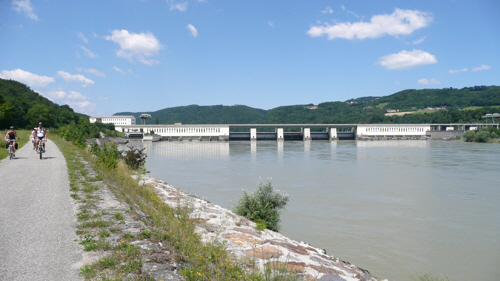
There were hydro-electric power stations on the Rhine between Germany & Switzerland about every 20kms or so and similarly on the German & early Austrian part of the Danube, but since mid-Austria, very few, although there is a very large hydro-electric station just beyond Bratislava in Slovakia just before the Danube passes into Hungary. The French who get over 70% of their electricity requirements from nuclear power, have at least 3 nuclear power stations along the Loire (a nuclear power station needs lots of water for cooling the reactors and for turning into steam to drive the turbines to make the electric) and the Swiss have one nuclear installation along their stretch of the Rhine (which we were told creates twice the amount of electricity as the 12 hydro-electric stations on the same stretch. Austria started to build a nuclear power station on the Danube but before completion there was an election and a change of government with an election promise of a referendum on the nuclear station – the people got their referendum and voted against, so build stopped and now they have what looks like a nuclear power station, but it doesn’t produce any power!! Governments – who’d ‘ave ‘em, eh??? Apparently we’ve yet to see the biggest dam on the Danube, built on a massive scale between Serbia & Romania in the 60’s & 70’s. Beside, is a picture of the Austrian hydro-electric power station at Ybbs with the barrage spanning the full width of the river.
Recycling facilities for travelling folk differ wildly from one country to the next, or the ease of use of the facilities. France was fairly straight-forward with lots of various containers for lots of different types of items, all clearly marked with nice pictures and a bin beside them for everything else. In Germany, the facilities were similar to France, but plastic bottles had a deposit paid at the point of purchase so you had to bring them back to the shop afterward and feed the bottles into a machine that would issue you with a ticket that could then be used as part-payment at the till. Some other countries had a similar system of deposit, but this time for glass bottles, but that doesn’t include wine bottles. Other countries (such as Hungary) have lots of recycling bins, but no nice pictures so you have to guess what goes where. So when we’re having our dinner in the evening, we have to decide how to split up our rubbish – cardboard separate from plastic, or all bunged into a bag? And tetrapaks separate for recycling, or rubbish? Not easy being a fully ecological traveller!!
I think we allowed ourselves our first beers in a bar, about 1 week into France and they cost about €3 each – and that was just in a village pub. By the time we’d reached Bratislava (capital city of Slovakia, last country on our route to use Euros) we were able to enjoy beers in a bar in the heart of the tourist district for €1.20 (but we had a bag of crisps in the same bar and it cost €2). In Budapest, we found a bar showing the Tour de France (after we asked them nicely) but their beer was the equivalent to nearly €2.50, yet just 30kms south of the city, the same glass of Soporoni was just less than €1.
Campsite fees for two people with a tent & a bike for one night, have varied quite a lot. England & Scotland were about £12 to £14. Republic of Ireland was actually quite expensive at around €20, while France had the cheapest (yet one of the nicest) at €6 but most were in the €12 to €15 bracket. Germany was a bit more expensive but also had the most expensive so far at €24 for one night in a nothing more than average site in Regensburg. In Budapest (where it was raining as we arrived) we managed to haggle a room in an apartment for two nights at just €20 per night, yet now (for reasons I’ve not yet mentioned) we’re in Novi Sad in Serbia paying €25 per night for a room in a hostel – and Novi Sad isn’t quite the international metropolis that Budapest is. But our budget couldn’t stick having to pay campsite fees every night, so as mentioned in previous blog entries, we camp wild about two-thirds of the time. And most campsites these days have wi-fi access somewhere on the campsite (normally in the vicinity of the reception).
Friendliness of folk on the street differs remarkably as well and how the people react to seeing us on our somewhat unusual bike. The Irish were probably the most vocal … or noisy … about their support for our bike as at least one in ten cars & trucks would hoot their horn (in a supportive fashion) at us, or cheer at us as we went past. The French were great too and we probably got most smiles from them, but just about every French person that we went past would say ‘Bonjour’ to us, and if somebody walked past us while we were having our bread & cheese lunch, they would bid us ‘Bon-appetite’ ! The difference from France to Germany was stark as so few Germans would allow themselves to react to our presence. In supermarket car-parks in France, people would come up and chat to us if they were interested in the bike, but in Germany, they would just look, but not approach us. The Czech people were 2nd best to the French. In Czech, the word for an informal “Hi” is “Ahoy”, and there are actually lots & lots of cyclists in the Czech Republic, and every one of them would greet us with a very hearty “Ahoy” as we went past – it was just like being aboard a pirate-ship! The Hungarians & Croatians were also friendly, with an almost Irish use of car-horns in support of us. An interesting number of big bikers (leather-clad Harley-Davidson types) also give us the thumbs-up as they pass us by (to the extent that Tamar is threatening to put some leather tassels on my handlebars in keeping with theirs), and many truckers do the same.
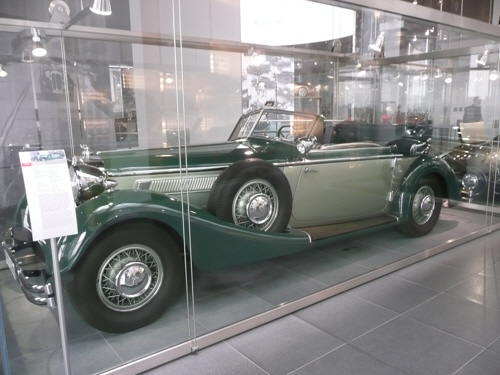
The cars that we see on the roads haven’t changed a great deal as we’ve crossed Europe. True, there’s nobody quite like the French when it comes to driving cars built in their own country, but for the most part, the cars on the street have been very similar to those at home in the UK. As we’ve moved into the former eastern bloc countries, we have seen more old eastern cars, but still plenty of new cars the same as you’d see in the UK, and I guess it could be said that there were a lot more Skodas (mostly new however) in the Czech Republic and in Slovakia (Skoda is Czech manufactured). The largest number of Trabants (East Germany’s answer to the Volkswagen Beetle & now sarcastically used as an icon of great communist engineering) however, have been seen in Hungary. I think there’s a certain irony that Trabants were built in the factory in eastern Germany that used to make the premium car brand (Horch) that became one of the four which merged post-WWII to form the Audi Auto Union. Beside, is a photo of a Horch car.
Finding water for drinking has been different in the many countries, but seems to be getting more difficult as we get further east. In France, Germany & Austria it was quite easy as most towns & villages had a tap somewhere, but when passing through Croatia, it was the first time we had to stop and ask some locals for water. We try to leave it till late in the day to get sufficient water for our dinner & breakfast, but on occasion we’ve bought it in the supermarkets, but that is far from easy, as you have first to work out which is carbonated and which is not, then which is flavoured and which is not, and now it seems that some countries sell bottled boiled water, which tastes really rather nasty!
Update on Location (as at Friday 29th July 2011)
We’re now in Novi Sad, 2nd city of Serbia, having passed through Slovakia, Hungary & Croatia over the last week or so. But we’re stuck here now for the next 4 or 5 days as we wait for a part to be sent to us once again. This time the necessary part is a complete new frame for the bike. It broke on Wednesday night as we pedalled up a hill into a forest looking for a place to put our tent for the night and while we heard the noise at the time, we couldn’t see what had broken. So Thursday morning, we came back down the same hill (at reasonable speed) with only one tube of the frame (instead of two) holding the front half & the back half of the bike together. With the way the bike was behaving we knew something wasn’t quite right but we couldn’t spot what, as when we would get off the bike to check it over, the location of the crack would close up, but then open up again when we put our weight on it. When we rode into Novi Sad, when stopped at some traffic lights, I looked down at the frame at the angle necessary to see the break in the frame, so some phone calls later, we now have a new complete frame making its way to us. So when it arrives, I’ll have to get all my spanners out and build up the new bike from the old.
Good fun this travelling lark!!
 threewheeling